Kyiv Turns Into a Front-Line City as Russian Strikes Intensify
Residents of Ukraine's capital sleep in subway stations, juggle school around air-raid alerts and brace for winter as Russian attacks make 2026 potentially the city's deadliest year of the war.
By News Media House Staff ·
Until a few months ago, daily life in Kyiv was relatively calm compared with areas near the front lines elsewhere in Ukraine. As Russia widens its attacks on the capital, that is no longer the case, and the city increasingly resembles a front-line zone.
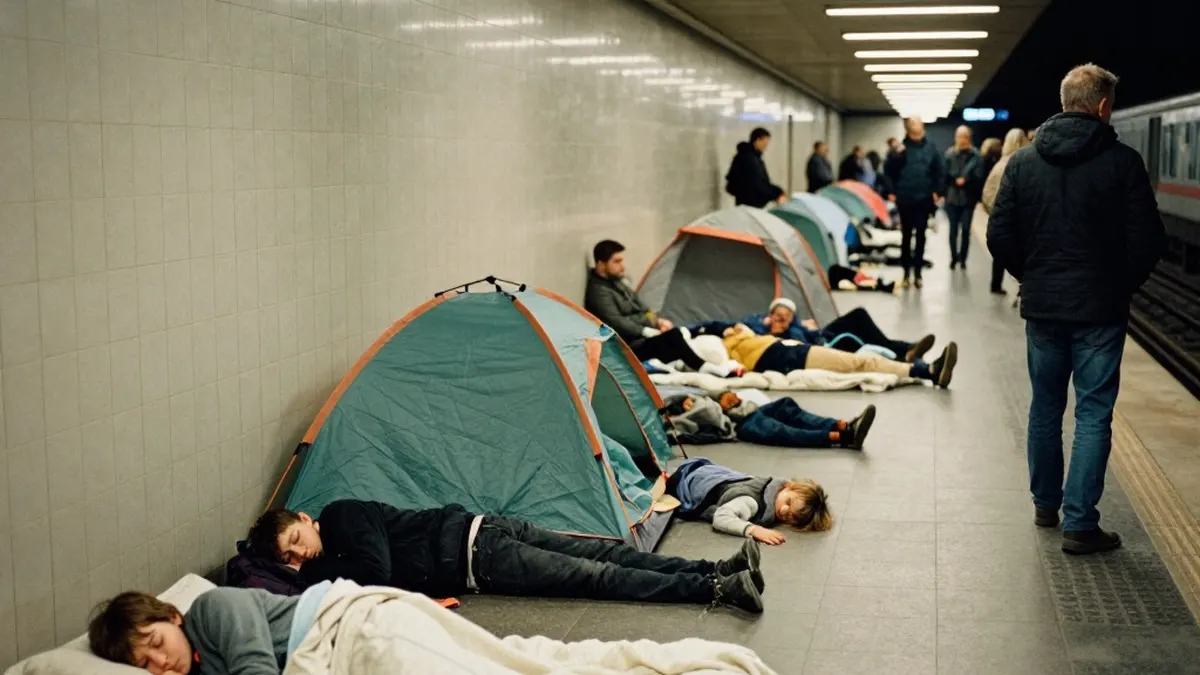
Because there are too few shelters for Kyiv's 4 million residents, subway stations have become improvised dormitories. From about 10 each night, people lay out mattresses and set up small tents. Children curl up beside adults, and pets settle next to their owners or among strangers along the cold walls.
"We're alive," a woman named Halyna told Deutsche Welle as she held her 5-year-old son, Roman. "We've been lucky once again." On most evenings, even without a siren, she takes him to the nearest station. Her apartment is in the Lukyanivka district, which Russia has repeatedly targeted during the war's four years and eight months.
The attacks have also claimed young lives. In September, 14-year-old Daniel Umanskyj was doing homework in his room when a Russian drone hit an apartment building in the central Pechersk district. A neighbor, Vlad, was in the hallway with his daughter at the time. "We were late that day, and this saved our lives," he said, adding: "These sick monsters don't care who they kill." Flowers now stand in front of the damaged building in Daniel's memory.
Places where children gather have been hit as well. In early October, a drone struck a school building in southwestern Kyiv, though pupils and teachers were already in shelters. Principal Valentyna Chorna said the school has kept teaching everyone in person because its large shelter can hold more than 500 students, allowing pupils in grades one through nine to attend.
Whether lessons go ahead depends on shelter availability and how long a siren lasts. If an alarm sounds in the morning while children are still at home, they may miss school. A colleague at DW's Kyiv bureau, whose daughter attends school near the Antonov aircraft factory, described the strain on parents who must go to work while a child stays home alone. Even the walk to school is risky, she said, since an alert can start at any moment. A Russian drone also struck their building in September; the apartment was undamaged and her daughter was at school at the time.
The toll is rising. Kyiv's military administration says 140 people were killed in the capital in the first eight months of 2026, against 172 for all of 2025. If that pace holds, this year could become the deadliest for Kyiv since the full-scale invasion began in 2022.
Strikes on warehouses have caused supermarket shortages on a scale not seen since the early months of the war. Emergency power outages returned at the end of September, and a Russian attack paralyzed the subway. With the energy infrastructure under fire, it is unclear how the city will reliably provide heat, electricity and water this winter.
Even so, residents remain resolute. The Kyiv International Institute of Sociology reported in early October that 72% of the city's residents said in September they were ready to endure the war as long as necessary. Authorities are trying to preserve normal routines: the curfew has been shortened to run from 1 a.m. to 5 a.m., and some facilities may operate during "yellow" alerts. During "red" alerts, which can signal ballistic or cruise missiles or large combined attacks, people must take shelter immediately.
Source: Deutsche Welle